Настоятельно рекомендуем вводить данные сразу в ГитСтат.
Уважаемые коллеги! Обращаем ваше внимание на то, что в форму “Проверки” с 01.10.2015 будет добавлена графа №18, в которой необходимо выбрать значение “Да” в случае, если проверка проводится по информации от Межведомственной комиссии
Уважаемые коллеги! При заполнении ежемесячного и ежедневного отчета Задолженность ЗП в графе 7 необходимо выбирать значение из словаря! Копирование значений из других отчетов или Excel недопустимо! Просим ответственно отнестись к данному требованию
Уважаемые коллеги!!!!!!!!!!!!!!!!!
В графе 6 – “Вид Экономической деятельности” необходимо выбирать более детализированный ОКВЭД. ЗАПРЕЩЕНО выбирать из словаря полное наименование раздела (Например: 01 Сельское хозяйство). Заполненные ранее ячейки в графе 6 необходимо заменить на конктретный (детализированный) ОКВЭД. Аналогичным образом необходимо заполнять графу 13 – “Вид (тип) несчастного случая” и графу 21 – “Причина несчастного случая” Данное требование необходимо выполнить в СРОК до 13 03 2015.

Федеральная служба по труду и занятости (Роструд)
Федеральная служба по труду и занятости (Роструд) представила доклад об основных направлениях разработки «Автоматизированной системы управления контрольно-надзорной деятельностью в сфере трудовых отношений» (АСУ КНД).
Ее создание предусмотрено в рамках реализации Концепции повышения эффективности обеспечения соблюдения трудового законодательства и иных нормативно-правовых актов, содержащих нормы трудового права (2014 – 2020 гг.), проект которой разработан Рострудом совместно с Минтрудом России.
Как говорится в докладе, АСУ КНД – комплексная централизованная система автоматизации Роструда, обеспечивающая на основе ключевых показателей целевое управление административными процессами контрольно-надзорной деятельности.
В настоящее время все 82 госинспекции труда используют типовое решение — «Автоматизированную информационную систему государственного надзора и контроля за соблюдением законодательства о труде» (АИС ГИТ). Система эксплуатируется с 2007 года и на данный момент, по мнению Роструда, обладает рядом недостатков, а именно:
- Отсутствие эффективной системы межведомственного информационного взаимодействия по вопросам соблюдения трудового законодательства.
- Отсутствие информационной системы поддержки современной концепции охраны труда, основанной на превентивном подходе и ориентированной на развитие «модели соответствия».
- Отсутствие технологических возможностей для сквозной автоматизации процессов, централизованного хранения первичных данных о проверках, отсутствие инструментов аналитической поддержки принятия управленческих решений на основе риск-ориентированных подходов.
- Нет технической и технологической возможности для применения системы КПЭ. Аналитическая отчетность не привязана к показателям. Отсутствие инструментов для визуального восприятия информации.
- Постоянный рост расходов на содержание АИС ГИТ, в силу того, что система децентрализована (для каждого региона используется отдельный сервер).
- Не используются математические алгоритмы обработки данных для аналитики.
- Отсутствие централизованной системы управления материальным и ресурсным обеспечением.
Роструд считает, что создание на основе действующей АИС ГИТ нового инструмента — АСУ КНД позволит
На уровне центрального аппарата Роструда:
- обеспечить управление процессами КНД на основе риск-ориентированной системы планирования;
- отслеживать рейтинги и ключевые показатели регионов, инспекций, инспекторов и работодателей, КПЭ инспекций и инспекторов;
- внедрить модель централизованного управления персоналом, бюджетом и материальными ресурсами Роструда и его территориальных органов;
- создать ситуационный центр руководителя Роструда и личные кабинеты сотрудников центрального аппарата Роструда;
- создать единую базу первичных данных, включая необходимые данные других ведомств;
- оптимизировать статистическую отчетность.
На уровне ГИТ в субъектах РФ:
- автоматизировать основные процессы контрольно-надзорной деятельности инспекции;
- создать средства интеллектуальной поддержки деятельности инспектора, инспекций;
- создать эффективный инструмент для работы инспектора.
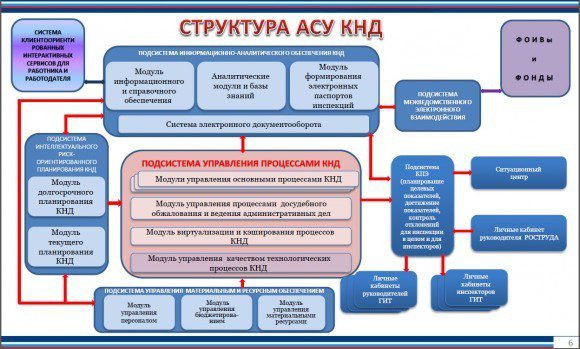
Из презентации заместителя руководителя Федеральной службы по труду и занятости М. Ю. Иванкова
В АСУ КНД будут включены Ситуационный центр, личный кабинет руководителя Роструда, личные кабинеты руководителей государственных инспекций труда и государственных инспекторов труда.
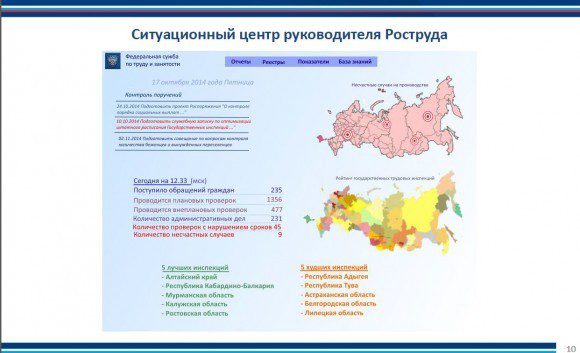
По расчетам Роструда, в результате создания АСУ КНД будет обеспечено:
- увеличение доли подконтрольных субъектов, в отношении которых проведены проверки, в общем числе подконтрольных субъектов;
- снижение общего количества нарушений законодательства о труде, в том числе сокращение числа нарушений обязательных требований трудового законодательства, представляющих угрозу причинения вреда жизни и здоровью граждан, имуществу физических и юридических лиц;
- увеличение доли лиц, положительно оценивающих качество работы ФИТ (в т.ч. по предупреждению и профилактике нарушений трудового законодательства);
- повышение эффективности государственного контроля (надзора) за соблюдением трудового законодательства и сокращение издержек проведения контрольно-надзорных мероприятий;
- снижение удельных затрат ресурсов на одно проверочное мероприятие.
Принципиальной особенностью АСУ КНД, как отмечают в ведомстве, является реализация в ее составе подсистем процессного сопровождения проверочных мероприятий и интеллектуального риск-ориентированного планирования КНД. Основу последней составляют механизмы категорирования и классификации рисков, базирующиеся на постоянно обновляемой и расширяемой базе знаний о структуре нарушений трудового законодательства в различных субъектах Российской Федерации, отраслях и видах экономической деятельности.
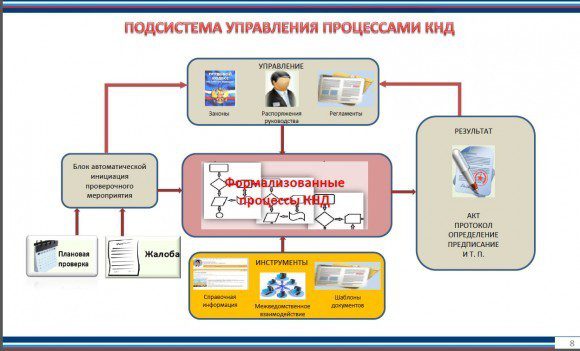
После утверждения Концепции и разработки соответствующей «дорожной карты» Роструд планирует приступить к полномасштабной разработке АСУ КНД.
Как сообщал D-Russia.ru, на состоявшемся 12 сентября очередном заседании подкомиссии по использованию информационных технологий при предоставлении государственных и муниципальных услуг Правительственной комиссии по использованию информационных технологий для улучшения качества и условий ведения предпринимательской деятельности Рострудом был представлен проект создания системы электронных сервисов Онлайнинспекция.рф, также являющейся частью Концепции повышения эффективности обеспечения соблюдения трудового законодательства и иных нормативно-правовых актов, содержащих нормы трудового права (2014 – 2020 гг.).
Система включает в себя комплекс сервисов, позволяющих работникам и работодателям получать в доступной форме исчерпывающую информацию о требованиях трудового законодательства и повышать уровень своих правовых знаний; обращаться за разъяснениями о порядке исполнения данных требований, оперативно получать необходимые инструкции и уметь применять нормы трудового права на практике; иметь неограниченный доступ к эффективным инструментам, предназначенным для устранения нарушений, защиты трудовых прав и реализации законных интересов граждан.
С ноября 2013 года на основе действующей системы консультирования, мониторинга и обработки сообщений о нарушениях в сфере трудового законодательства«Онлайнинспекция.РФ» в пилотном режиме осуществляется эксплуатация прототипов ряда из упомянутых сервисов. Наиболее важные и значимые из них — «Вопросы дежурному инспектору» и «Сообщить о проблеме».
Следите за нашим Телеграм-каналом, чтобы не пропускать самое важное!
Поделиться
- Системы автоматизированной сборки ПО Наши DevOps инженеры разрабатывают и внедряют различные системы автоматизированной сборки ПО для таких технологических платформ, как Java, .NET , мобильные приложения для IOS и Android, Node.js и другие.
- Continuous Integration (CI)/ Continuous Delivery (CD)DevOps инженеры Git in Sky настраивают Continuous Integration (Непрерывная интеграция) и Continuous Delivery (Непрерывная поставка) на базе GitLab CI с использованием таких механизмов управления, как Ansible и других. Это улучшает качество программного продукта и уменьшает сроки его поставки. В результате наши специалисты могут использовать различные модули, в том числе и контейнеры Docker, помогут развернуть систему оркестрации контейнерами с помощью Kubernetes и других.
- Управление релизами проектов/продуктовDevOps инженеры Git in Sky на профессиональном уровне организовывают процессы поставки релизов в сотрудничестве со всеми вовлеченными командами и помогают настроить процессы управления версиями (включая VCS и системы управления проектами), планирования релизов и поставок.
- Мониторинг и резервное копирование Выстраиваем централизованную систему превентивного мониторинга. Система охватывает все приложения и стеки ПО, серверы, низкоуровневые метрики, бизнес метрики и имеет алерты. У нас лучшие эксперты по мониторингу IT-инфраструктуры с использованием инструментов Prometheus и Grafana.
- Установка сторонних программных комплексовНаша команда DevOps может установить и настроить готовые сторонние решения: реляционные базы данных, NoSQL базы данных, системы контроля версий (VCS) и связанную инфраструктуру, файловые репозитории, поисковые платформы, брокеры сообщений, различные веб-серверы и серверы приложений, системы управления проектами и задачами, включая отслеживание ошибок и многие другие.
Attributable to Identified Sources
AIS is an evaluation framework for assessing whether the output of natural language models only contains information about the external world that is verifiable in source documents, or attributable to identified sources.
This repository contains annotations for model output on four source datasets (CNN/DM, QReCC, Wizard of Wikipedia, and ToTTo). We provide the model output and annotations. The detailed description of our evaluation methodology, including the annotation guidelines, annotation interfaces, and operational statistics are included in our paper.
Data CSV Formats
Each row in our csv file corresponds to a produced summary (output) by a certain model (model-name) with the consensus annotations by our annotators and a count of how many annotators voted for the consensus. In order to access the input article that was being summarized, you will have to download a copy of CNN/DM and match the rows using the “doc-url” and “doc-url-hash” fields in our csv files.
- Download the CNN/DM summarization data (if downloading the raw articles, be sure to strip the articles of the gold summary highlights before using). Note: An example of instructions for correctly downloading and processing the articles can be found at https://github.com/abisee/cnn-dailymail.
- Depending on the version of CNN/DM that you use, it may have identifiers for the articles stored in one of two ways that can be used to map to rows in our csv files:
- Using the article URL: In each row in our csv files, we include a doc-url field which contains the URL of the original source article. For some versions of CNN/DM, this can be used to map to the correct article in CNN/DM data
- Using the article ID: In each row in our csv files, we also include a doc-url-hash field which is the heximal formatted SHA1 hash of the URL. For some previously released versions of the CNN/DM dataset, this hashed version of the URL was used as an article id and can be used to map to the correct article in the CNN/DM data.
Additional Notes
We also include an ex-idx field in our csv files. This corresponds to the row (starting from 0) in the CNN/DM test files that were provided by this repo for the test set examples.
References
These annotations were made using the CNN/DM dataset, originally developed by Nallapati, Ramesh, Bowen Zhou, Caglar Gulcehre, and Bing Xiang. “Abstractive text summarization using sequence-to-sequence rnns and beyond.” In Proceedings of the 20th SIGNLL Conference on Computational Natural Language Learning (2016).
For generating model output, we used publicly available models.
Matchsum: Zhong, Ming, Pengfei Liu, Yiran Chen, Danqing Wang, Xipeng Qiu, and Xuanjing Huang. “Extractive summarization as text matching.” In Proceedings of ACL (2020).
Pointer-Generator Networks: See, Abigail, Peter J. Liu, and Christopher D. Manning. “Get to the point: Summarization with pointer-generator networks.” In Proceedings of ACL (2017).
QReCC Data {#QReCC-data}
Each row in our csv file corresponds to a produced summary (output) by a certain model (model-name) with the consensus annotations by our annotators and a count of how many annotators voted for the consensus. In order to access the input document passage and the conversation history, you will have to download a copy of QReCC data and match the rows using the doc-url and ex-idx fields in our csv file.
- Download the QReCC data (preferably the version included in the SCAI QReCC 2022 challenge data which is also accessible here with instructions for processing).
- The ex-idx field that we provide in our csv file can be used to lookup the full conversation information in the QReCC data. The format of the ex-idx field is Conversation_no:Turn_no where the Conversation_no and Turn_no correspond to fields in the qrecc_test.json file provided by the SCAI QRECC 2022 challenge data.
Instructions on how to download the grounding document passages
- Download the QReCC data (preferably the version included in the SCAI QReCC 2022 challenge data which is also accessible here with instructions for processing).
- To find the appropriate source passage, use the passage identifier that we provide in the doc-url field. The identifiers consist of a URL where the passage is located appended with a passage marker (_p0, _p1, _p2, etc.) denoting which passage was selected from the html page as the source. Please see the SCAI QRECC challenge set code for how to properly extract the corresponding passage using this information. Note: The original QRECC data sometimes lists multiple passage candidates for each utterance, so please refer to our doc-url field to verify which passage we used.
These annotations were made using the QReCC data was originally developed by Anantha, Raviteja, Svitlana Vakulenko, Zhucheng Tu, Shayne Longpre, Stephen Pulman, and Srinivas Chappidi. “Open-domain question answering goes conversational via question rewriting.” In Proceedings of NAACL (2020).
Models used were variants of T5: Raffel, Colin, Noam Shazeer, Adam Roberts, Katherine Lee, Sharan Narang, Michael Matena, Yanqi Zhou, Wei Li, and Peter J. Liu. “Exploring the Limits of Transfer Learning with a Unified Text-to-Text Transformer.” Journal of Machine Learning Research (2020).
Wizard of Wikipedia Data
Each row in our csv file corresponds to a produced summary (output) by a certain model (model-name) with the consensus annotations by our annotators and a count of how many annotators voted for the consensus. In order to access the input document passage and the conversation history, you will have to download a copy of Wizard of Wikipedia and match the rows using the ex-idx field in our csv file.
- Raw Wizard of Wikipedia json files can be downloaded directly from http://parl.ai/downloads/wizard_of_wikipedia/wizard_of_wikipedia.tgz (or implicitly using Parlai library). All of our examples come from the test_random_split.json file.
- Use the ex-idx field of our csv files to access the conversation history and source passage:
Wizard of Wikipedia data was originally created for the paper: Dinan, Emily, Stephen Roller, Kurt Shuster, Angela Fan, Michael Auli, and Jason Weston. “Wizard of Wikipedia: Knowledge-Powered Conversational Agents.” In International Conference on Learning Representations. (2018).
For producing model output we used models from:
- Dinan, Emily, Stephen Roller, Kurt Shuster, Angela Fan, Michael Auli, and Jason Weston. “Wizard of Wikipedia: Knowledge-Powered Conversational Agents.” In International Conference on Learning Representations. (2018).
- Shuster, Kurt, Da Ju, Stephen Roller, Emily Dinan, Y-Lan Boureau, and Jason Weston. “The Dialogue Dodecathlon: Open-Domain Knowledge and Image Grounded Conversational Agents.” In Proceedings of the 58th Annual Meeting of the Association for Computational Linguistics, pp. 2453-2470. 2020.
- Raffel, Colin, Noam Shazeer, Adam Roberts, Katherine Lee, Sharan Narang, Michael Matena, Yanqi Zhou, Wei Li, and Peter J. Liu. “Exploring the Limits of Transfer Learning with a Unified Text-to-Text Transformer.” Journal of Machine Learning Research (2020)
- Rashkin, Hannah, David Reitter, Gaurav Singh Tomar and Dipanjan Das. “Increasing Faithfulness in Knowledge-Grounded Dialogue with Controllable Features.” In ACL (2021).
ToTTo Data
Each row in our csv file corresponds to a produced summary (output) by a certain model (model-name) with the consensus annotations by our annotators and a count of how many annotators voted for the consensus. In order to access the input table, you will have to download a copy of the Totto dataset and match the examples using the ex-idx field in our csv file.
- Instructions for downloading and processing the Totto source files can be found on their git repo.
- The tables can be accessed by matching the ex-idx field in our csv file with the example_id field in the Totto source files. For the model-written outputs, all examples are extracted from the Totto test set (unlabelled_totto_test.json). For the human-written outputs (model-name is reference_final and reference_original), the examples form from the Totto dev set data (totto_dev.json).
reference_final vs. reference_original: The Totto data includes multiple human-written sentences for each example including the raw table descriptor before it was cleaned by annotators (original_sentence) and the gold reference that has been cleaned by crowdworkers (final_sentence). In our paper, we only reported the results for annotating the AIS of the final_sentence, which is treated as the gold reference. However, in this data release, we have included annotations for both sets of human-written sentences (model-namedenoted as reference_original and reference_final).
ToTTo data was originally developed as part of this data: Parikh, Ankur P., Xuezhi Wang, Sebastian Gehrmann, Manaal Faruqui, Bhuwan Dhingra, Diyi Yang, and Dipanjan Das. “ToTTo: A controlled table-to-text generation dataset.” In Proceedings of EMNLP (2020).
Model output comes from the T5/ByT5 models used for GEM:
- Gehrmann, Sebastian, Tosin Adewumi, Karmanya Aggarwal, Pawan Sasanka Ammanamanchi, Aremu Anuoluwapo, Antoine Bosselut, Khyathi Raghavi Chandu et al. “The GEM Benchmark: Natural Language Generation, its Evaluation and Metrics.” In 1st Workshop on Natural Language Generation, Evaluation, and Metrics 2021, pp. 96-120. Association for Computational Linguistics, 2021.
- Xue, Linting, Aditya Barua, Noah Constant, Rami Al-Rfou, Sharan Narang, Mihir Kale, Adam Roberts and Colin Raffel. “ByT5: Towards a Token-Free Future with Pre-trained Byte-to-Byte Models.” Transactions of the Association for Computational Linguistics 10 (2021): 291-306.
- Raffel, Colin, Noam Shazeer, Adam Roberts, Katherine Lee, Sharan Narang, Michael Matena, Yanqi Zhou, Wei Li, and Peter J. Liu. “Exploring the Limits of Transfer Learning with a Unified Text-to-Text Transformer.” Journal of Machine Learning Research (2020).
Note about Hallucinated Content
This data is intended for measuring the types of mistakes made by models when producing output that is not attributable to a source. As such, the model outputs include hallucinated or incorrect information about real-world entities (for example statements about public figures, organizations, people mentioned in CNN news stories, news writers etc.). Some model output examples also include misspellings (e.g. misspelled names) and formatting errors (e.g. unks, unicode issues). People intending to use this data for any other purposes aside from measuring attribution issues should be aware that the model output includes these types of hallucinations and that the model output should not be treated as factually correct information.
Citations
If you use this data, please cite our paper:
Self-Service Analytics Platform for Global Shipping Network
KnowAIS project won first place and Best Visualization in The UN Big Data Hackathon 2022 Big Data Expert Track.
https://unstats.un.org/bigdata/events/2022/hackathon/winners-bde.cshtml
Cerdasdata Team Members
- Ignatius Aditya Setyadi BPS – Statistics Indonesia
- Amanda Pratama Putra Tokopedia
- Wismu Sunarmodo BRIN – National Research and Innovation Agency
- Sugiri BPS – Statistics Indonesia
- Amin Rois Sinung Nugroho BPS – Statistics Indonesia
Presentation Video
- Develop decision support system to process AIS Big Data in timely manner through insight generation and monitoring of global shipping network.
- Conduct analysis using Data Science and Big Data related to the relationship between global shipping networks and statistical indicators of the world economy.
Port data
Data taken from the World Food Programme (WFP) and filtered only by area.
The designated h3 resolution 5 along its hex ring from its centroid point is then defined as the polygon to be utilized for trajectory identification.
Official statistics
The UNCTAD-Eora Global Value Chain (GVC) database offers global coverage (189 countries and a “Rest of World” region) and a time series from 1990 to 2018 of the key GVC indicators: foreign value added (FVA), domestic value added (DVA) and indirect value added (DVX).
Results from 1990 to 2017 are generated from EORA Multi-Region Input-Output tables (MRIOs). Results for 2016-2017 are provisional “beta” results and will be revised in early 2018. Results for 2018 are nowcasted based on the IMF World Economic Outlook.
Scope
Baltic and Black Seas are picked as the targeted zone to analyze the impact of the Ukraine-Russia war.
The selection across the zone is made using H3 resolution 1 and its hex ring, which consists of 14 areas, in the period of January to June 2022 (~10M records after sampling), as well as the same month period from 2021 (~9M records) for comparison.
Big Data processing
For better performance dealing with Big Data, initial filtration is performed on selected columns, h3_list in resolution 1, and date range
Port activity identification
Identification activity in the port area is done by joining with the same h3 index resolution 5 between AIS Data and Ports. This approach has proven produced better performance than scripts using GIS features such as ST_WITHIN, etc.
It also reduces the need to define specific coordinates locations in order to manually generate port polygon area.
Speed & distance calculation
The distance is measured using the Haversine formula and carried out between movements, then the speed calculation is carried out afterwards.
The distance is carried out in km, as well as the speed produced in km per hour (kmh)
Anchored identification
Anchored identification is tracked from several conditions, mainly based on the length of time in port and the time difference which tends to be longer than the next emergence, which is currently limited to a minimum of ± 2.5 hours.
Trajectory result
The trajectory results contain the shipping lineage attributes, namely average speed, distance, and vessel identity such as mmsi, type, width, length, country, etc.
The distance is calculated by aggregating each movement of the vessel during the trip rather than simply calculated directly from the place of origin to the destination.
Use case
- Route Recommendation
- Country & port clustering
- Country & port ranking
- AIS2Vec: Country & Port Vector Embedding based on AIS Shipping Network
About the repository
- AIS Data access at UNGP. Only able to use small sample size. It might impact the accuracy of OD matrix.
- Availability data to enrich knowledge graph, along with the commitment of the availability
- MapBox free private API token which only limits 50k hit/ months
Roadmap
- Platform developments which enables more enhance decision support system.
- Integrate with more available data, mainly from official statistics and other relevant data.
- Improve the backend integration and study the best practice architecture that might sustain for a long time and easy to scale using cloud architecture.
- Provide more broadened and advanced analytics which will enrich data-driven solution.
- Focus as the measurement platform on controlling SDGs Goals
Appendix
S3 Bucket Trajectory Result Repository
First, What is Git?
Git is a DevOps tool used for source code management. It is a free and open-source distributed version control system used to manage small and large projects efficiently. Git tracks changes to source code, allowing multiple developers to collaborate on non-linear development.
Before Git
Previously, developers sent code to a central server without a copy of themselves. Changes to the source code are not known to other developers. There was no communication between the developers.
After Git
- Every developer has a local copy of the code
- Source code changes can be tracked by others
- Developers regularly communicate with each other
How Does Git Work?
The project has several savepoints during the development stage. Those save points are called “commits.” Every modification made to the project during development, or a commit, is listed in the commit history. Commit allows for rolling back or forwarding the code to any commit history commit.
To refer to commit, Git uses “SHA-1 hashes”. Every hash points to a specific commit in the repository. With the help of hashes, Git creates a tree structure for easy data storage and retrieval.
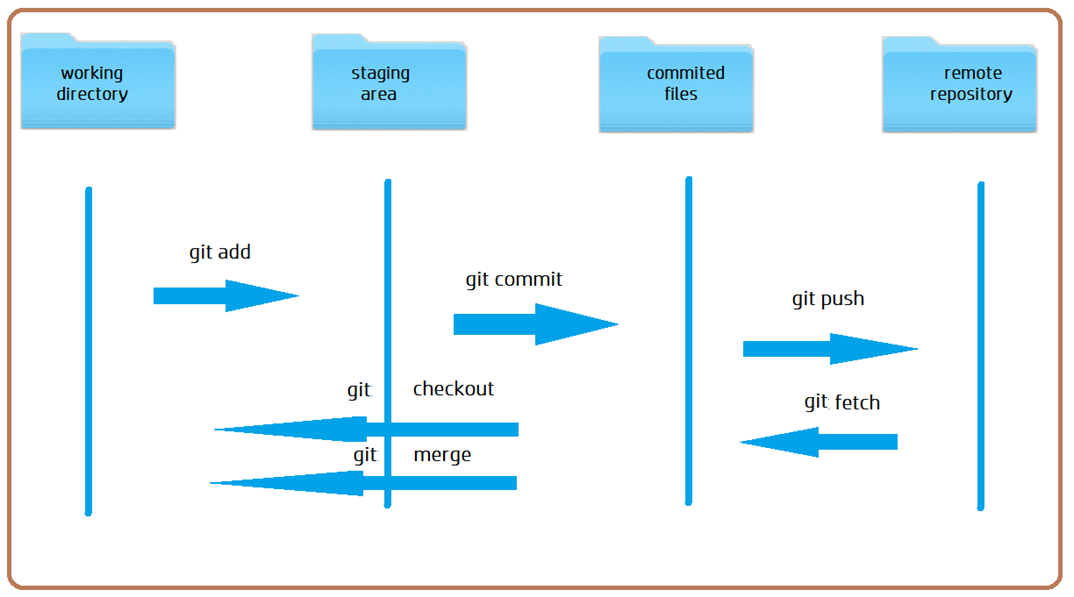
Each Git project’s files go through several stages:
- Working Directory: This stage has modified files, but they are untracked and not yet ready to commit.
- Staging Directory: Modified files are prepared for commit when added to the staging environment.
- Committed: File snapshots from the staging area are saved in the commit history.
Basic Git Workflow Diagram
Staging
To track changes made to a file it must be added first to the staging area. Whenever a file is modified, Git recognizes it, but unless and until it is not staged, Git does not track it. The staging area adds an extra layer of security that allows us to audit the changes before they are pushed to commit.
It is the preliminary step for all the files to be in the staging area before they are pushed to commit, i.e., deployed on the master branch.


Commit
These are like snapshots of our work, a snapshot of the repository at a specific time. Commit snapshots do not change unless specifically executed.
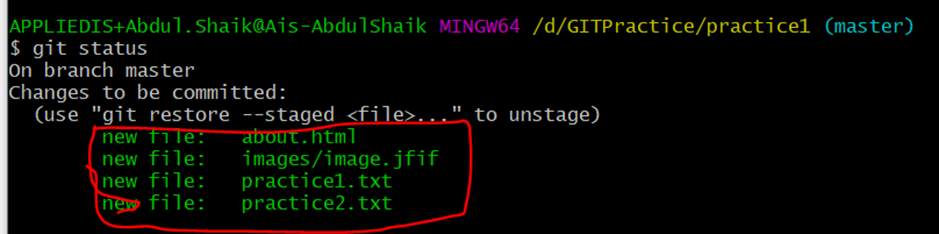
We see in the above screenshot that four files are ready to commit.
To commit them, we use the syntax: git commit -m “Notes about the commit”
The output will have the commit and states what has been changed.
Commit history can be checked using the below command: git log
The result will give us the history that includes information on who made commits and what those commits are when it was made, and the description of the commit.
Adding – oneline flag will display the history in a one-liner.

Reverting
We can get the information of commit_ID using the command: git log
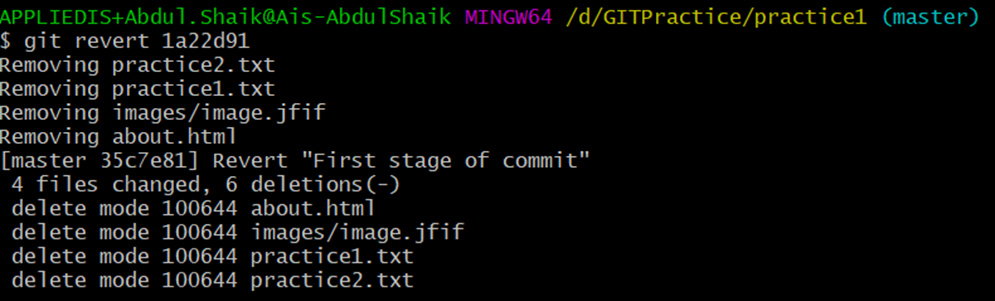
The Git reset command takes back to a particular point in the development permanently. If we want to re-add files or updates that were added after that time, they are all unstaged.
Branching
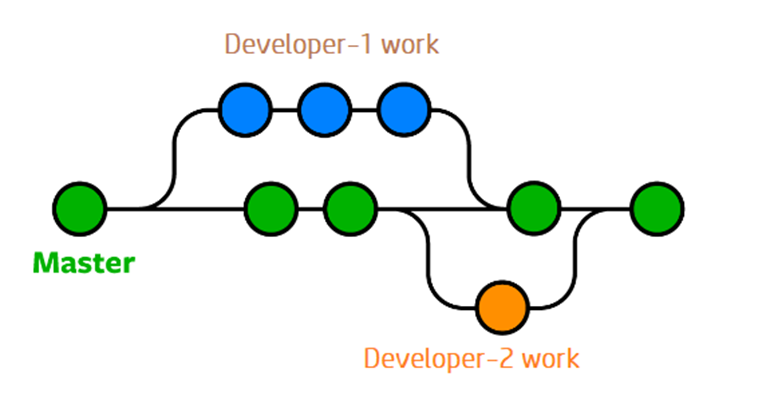
Git branching enables programmers to deviate from the code in use to correct bugs or add features. To work with a copy of the code without altering the original, developers create branches. To isolate the code changes, we establish branches. We test these branches before integrating them into the main branch.
The master branch is nothing but the stable version of the code which is created when we initialize a Git repository using the Git init command.

Merging and Conflicts
Once the developers finish their work on a new feature or a bug fix on a separate branch, using the git merge command, the developers can
merge their changes to the main branch without sending the work to other developers in the project. Merging changes entails incorporating the code into the master branch.
Existing branches can be seen using the command: git branch -a

- We need to switch to the master branch.
- git checkout master
- Once we switch to the master branch to merge the branch, we use the command below:

A conflict occurs when someone decides to make changes to the master branch while we are working on another branch. This type of conflict occurs when we attempt to merge changes with the master branch, which is now distinct from the code copy.
Fetching and Pulling Changes
To retrieve changes from the remote repositories, use git fetch and git pull commands.
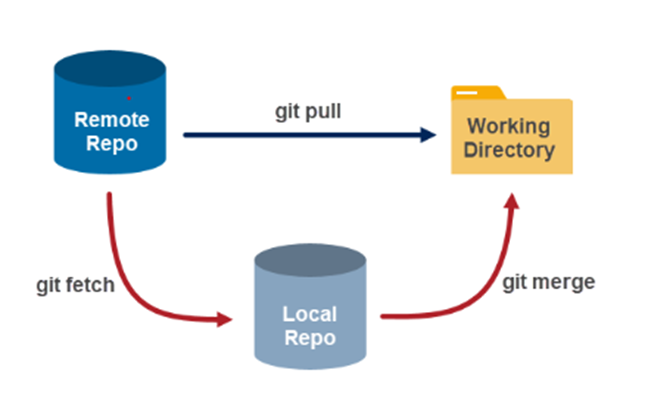
git fetch only fetch all the changes that are in the remote repository. There will be no changes to the local repository.git pull fetches the metadata from the remote repository and adds new changes to the local repository.
In general git pull = git fetch + git merge
Pushing Changes
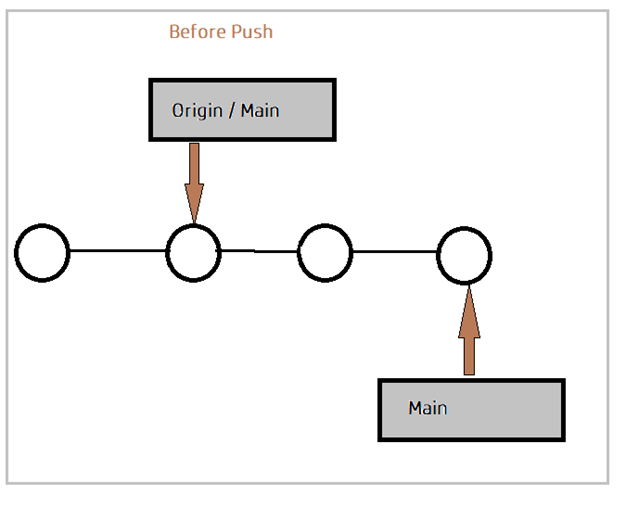
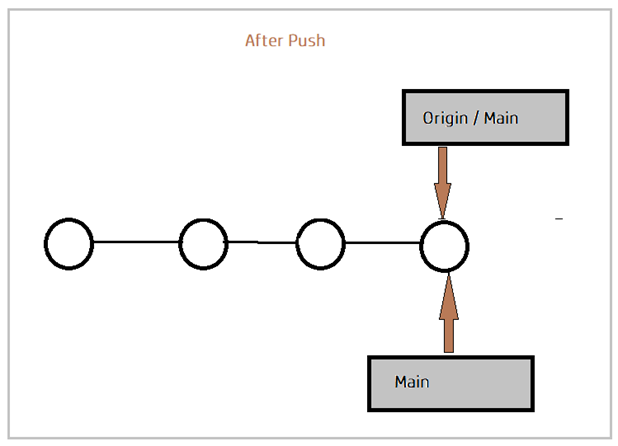
When you make changes locally and want to push them to a remote repository, run: git push
Rebasing
Git makes a copy of the existing code when we create a branch so we can continue to work on it. To keep up with general development, developers might occasionally need to incorporate fresh modifications from the master branch.
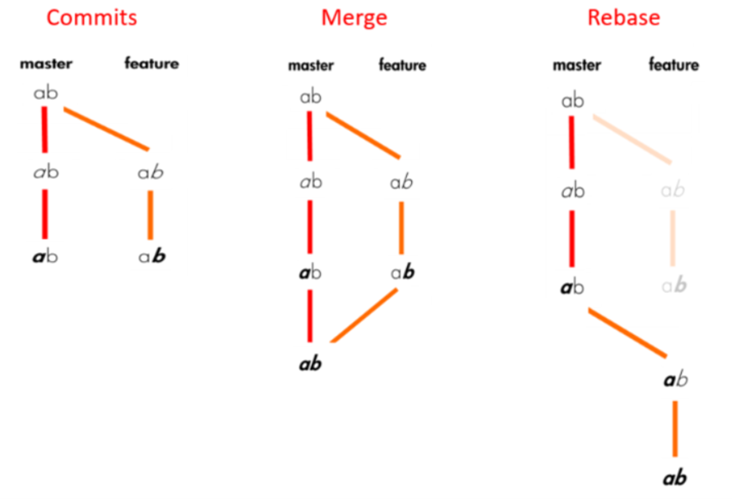
Rebasing entails merging fresh changes from your feature branch into the master branch. Git then creates commits on top of the tip of your feature branch by replaying the most recent modifications from the master branch.
- Use the below command to rebase the branch.
git rebase master. - git rebase master.
Both rebasing and merging, but in different methods, are intended to incorporate changes from one branch into another branch. In pictorial representation if we have commits as shown below, the merge will result in a combination of commits, whereas rebase will add all changes in the feature branch beginning with the last commit of the master branch:
Conclusion
There are definite benefits of using Git. It saves time, works offline, undoes mistakes, and tracks changes. With this, we get an idea of what Git is and how it works, basic commands to use in Git, and what is branching, merging, rebasing, push and pull. I hope this should help move forward in learning Git.
Приглашаем в команду PHP разработчиков (Junior/Middle/Senior)
Мы, государственная компания, специализируемся на разработке программного обеспечения, связанного с автоматизацией государственного сектора и бизнес сектора. Мы растем и развиваемся, в связи с чем, ищем к себе в команду единомышленников, готовых к совместному достижению поставленных целей.
- Профильное высшее образование или сертификаты о завершении курсов и программ для разработчиков ПО;
- Знание PHP фреймворков Yii2, Symphony, или подобных;
- ООП;
- Знание паттернов разработки и умение применять их на практике;
- Умение писать составные запросы на SQL;
- Понимание REST/SOAP;
- Умение работать с Git
- Умение работать в команде (GIT-flow);
- Логическое мышление;
- Знание HTML, CSS, JS.
- Участие в полном цикле разработки ПО (написание кода, тестирование, внедрение и сопровождение);
- Разработка клиентских и серверных приложений;
- Сопровождение и развитие существующего ПО.
Что мы предлагаем:
- Трудоустройство согласно законодательства КР;
- 5-ти дневная рабочая неделя;
- Стабильная зарплата;
- Оплачиваемый отпуск;
- График работы с 9.00 до 18.00 (возможны изменения)
- Обучение и повышение квалификации за счет компании;
- Сложные и интересные проекты, которые позволяют постоянно повышать уровень своего профессионализма;
- Комфортные условия для работы (во время отдыха возможность расслабиться с PS);
- Тимбилдинги, веселые корпоративы и совместные поездки (на ИК, в горы).
30000 – 200000 сом в месяц
Наиболее подходящие кандидаты будут приглашены на собеседование
Приглашаем в команду C# разработчиков (Junior/Middle/Senior)
- Профильное высшее образование или сертификаты о завершении курсов и программ для разработчиков ПО;
- Владение C# 7.0 и выше;
- Знание .Net Framework 4+, .Net Core 1+;
- понимание принципов ООП и чистого кода;
- Знание паттернов разработки и умение применять их на практике;
- Transact-SQL, SQL Server, Postgre SQL
- WinForms, Web Services, Web API, ASP.NET MVC, WCF
- NHibernate, LINQ, Entity Framework
- Умение работать в команде (GIT-flow);
- Логическое мышление;
- HTML, CSS, JS, jQuery, AJAX (Знание технологии ReactJS будет плюсом)
- Участие в полном цикле разработки ПО (написание кода, тестирование, внедрение и сопровождение);
- Разработка клиентских и серверных приложений;
- Сопровождение и развитие существующего ПО;
Middle Java разработчики
– Опыт работы в командной разработке от 2-х лет;
– Уверенное знание Java SE;
– Хорошее знание Java EE;
– Умение писать составные запросы на SQL;
– Знание ООП, Git, JPA-Hibernate, REST/SOAP, HTML, CSS, JS;
– Профильное высшее образование или сертификат о завершении IT курсов;
– Разработка клиентских и серверных приложений;
– Сопровождение и развитие существующего ПО;
– Заработную плату 85-150 тыс. сом (на руки);
– Трудоустройство согласно законодательства КР;
– График работы 5/2, с 9:00 до 18:00;
– Оплачиваемый отпуск;
– Комфортные условия для работы (комната отдыха с PS);
– Обучение и повышение квалификации за счет компании;
– Сложные и интересные проекты, которые позволяют постоянно повышать уровень своего профессионализма;
Наиболее подходящие кандидаты будут приглашены на собеседование.
В команду ГП “Инфоком” при МЦР КР нужен специалист, который:
• Имеет портфолио;
• Может сверстать макеты сложнее простого сайта-визитки;
• Верстает адаптивно, кроссбраузерно;
• Умеет пользоваться Google;
• Умеет пользоваться CSS и JS плагинами. Знает, когда стоит их использовать, а когда нет;
• Знает JS хотя бы на базовом уровне. Способен написать небольшой скрипт без использования библиотек и фреймворков;
• Может сверстать в точности так, как представлено в дизайн-макете;
• Имеет опыт работы в команде и коммерческой разработке;
• Использует в своей работе o Gulp, Sass, VS Code (или любой другой редактор с emmet), Git, Githubo BEM, Flexboxo Figma (на базовом уровне)o SVG (в том числе спрайты)o CSS-анимации (может сам создать базовые, если надо).
• Умение сверстать страницу при помощи WordPress;
• Знание Photoshop, Illustrator (на базовом уровне).