О нас
Специализированная компания KAND s.r.o. занимается производством и продажей вкусностей. Среди нашей продукции можно найти кетчупы, горчицы, клюкву и соусы. Совместно с нашими дочерними компаниями, входящими в холдинг Develey Senf & Feinkost, мы предоставляем продажу специальных горчиц, хрена, уксусов, сиропов и кетчупов.
Вся наша продукция выпускается с максимальной искренностью и заботой. Мы тщательно подбираем все ингредиенты и гарантируем их высокое качество. Нам важно, чтобы то, что не нравится нам, мы не производили. Мы бережно относимся к удовлетворенности наших клиентов, традиционному чешскому бренду, качеству производства и сырья.
Новые дизайны кетчупов
Свежие дизайны кетчупов Kand обязательно привлекут ваше внимание, так же как и их насыщенный вкус и состав. Уже более 50 лет традиционный продукт, насыщенный помидорами, без красителей, крахмала и химических консервантов. С кетчупами Kand, приготовленными из помидоров, вы порадуете не только детей, но и взрослых. Они незаменимы для гриля, семейного барбекю. Попробуйте сладкий, с чесноком или с чили. Попробуйте традиционный вкус кетчупов Kand, которые производятся у нас в Чешской Республике.
Высокое содержание помидоров
Уже несколько лет мы являемся обладателями высшего уровня сертификации IFS, благодаря которой вы можете приобретать нашу продукцию в сетях. Мы регулярно проходим строгие аудиты, чтобы сохранить высокий уровень производственного процесса и нашей продукции.
Большинство наших товаров гордятся престижным знаком Класса.
Наше ежегодное участие в конкурсе Чешская вкусовка принесло нам множество наград как за кетчупы, так и за горчицы, клюкву и соусы.
Политика окружающей среды и энергетики
Мы активно интересуемся тем, как наша работа может повлиять на окружающую среду. Поэтому мы присоединились к системе энергетического и экологического менеджмента и сократили тем самым воздействие на окружающую среду до минимума. Мы подробно раскрываем этот вопрос ниже.
Потому что каждый из нас имеет значение.
Руководство компании Develey Senf & Feinkost GmbH и ее дочерние компании осознают свою ответственность перед окружающей средой. Для выполнения этой ответственности мы обязались минимизировать воздействие на окружающую среду путем внедрения и поддержания системы энергетического и экологического менеджмента. Нашей целью является постоянное снижение потребления энергии на произведенный нами продукт. Все области в компании регулярно проверяются и часто происходят улучшения, которые внедряются выше требуемого законом уровня.
Мы готовимся к внедрению требований ISO 14001, чтобы процессы в рамках системы экологического и энергетического менеджмента постоянно совершенствовались. Так называемое непрерывное улучшение подразумевает, что несмотря на все усилия по достижению положительной динамики, существуют моменты, когда на короткое время возможно отрицательное развитие.
Энергетическая и экологическая политика
Продажные дни
Vojta je hudební nadšenec a vděčný strávník
By training a molecular biologist, I held jobs in research, science politics, product management, project management and science journalism. Now, I am now trying to get the best quality of life for my son and pursuing a nice work-life balance.
Italy

Poland

United Kingdom
Sally Blaxall
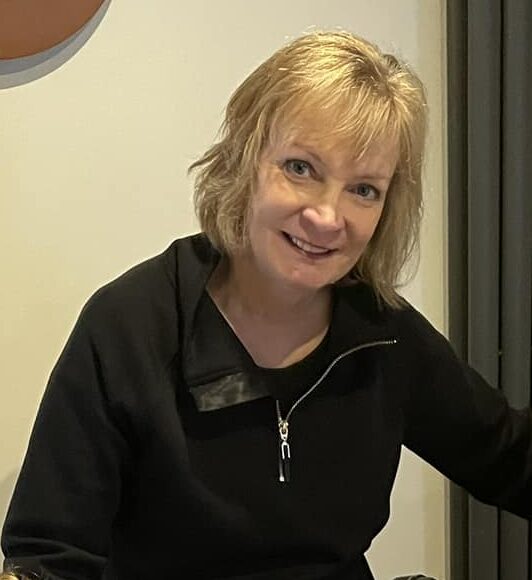
My identical twin daughters’ Eleanor & Florence were diagnosed in 2015, aged 18, and are now 26 and living in Supported Living during the week with 24 hour care in Maidstone in Kent, 30 mins from our home and return home most weekends. Once a month they stay at their Supported Living home at the weekend to give some respite for myself and my husband.Having lived through the UK “system” I hope to help those families in the UK navigate their own paths and have met with other families in London for lunches which we have all enjoyed, sharing experiences and stories.
Australia

Gary Boyer
Primarily, Gary is a father of Edward, Azalea and Oliver and a husband to wife Catherine. He has been heavily involved in KIF1A.org since 2019, his motivation assisting to find a cure that will improve Edwards quality of life, but also wanting to help all the impacted people who have KIF1A so that it is permanently cured and the kids and families can live a normal life.
Gary lives in Bendigo, a small town in Victoria, Australia. He liaises with local researchers in Australia at Murdoch Childrens Research Institute at the Royal Childrens Hospital in Melbourne and Childrens Medical Research Institute at Westmead Hospital in Sydney. He also loves meeting new families and talking about the possibilities a future of a world where KIF1A no longer is an issue. While not being an expert and is “just a dad”, he is good at understanding scientific terms and explaining them in “lay-mans” terms so that scientific messages can be better understood.
He is a board game lover and regularly travels internationally for board game events. He is also known to pretend to be good at golf as well as enjoy watching Australian Rules Football.
Canada
Salima joined the KIF1a family support group in 2022 after her 17 year old daughter Sophia was diagnosed with KAND. She has worked part time in her career as a dentist alongside being a very involved and strong advocate for support, inclusion and therapy for Sophia. Her passion is to be able to do as much as possible to enable families and children with disabilities to access and participate as much as possible in daily life and help provide support to families facing the many challenges that present themselves. Having been on this journey for 17 years with Sophia, Salima has gained much insight into many aspects of daily living skills, social support and education and currently she is enrolling in a program to become a qualified rehab assistant. Salima is excited to both learn, grow and contribute with the KIF1a organization.
Born22 April 1724Königsberg, Kingdom of Prussia(present-dayKaliningrad, Russia)
Died12 February 1804 (aged 79)Königsberg, East Prussia, Kingdom of Prussia
EducationUniversity of Königsberg (BA; MA, 1755; PhD, 1755; PhD, 1770)
EraAge of Enlightenment
InstitutionsUniversity of Königsberg
Academic advisorsMartin Knutzen, Johann Gottfried Teske (M.A. advisor), Konrad Gottlieb Marquardt
Notable studentsJakob Sigismund Beck, Johann Gottfried Herder, Karl Leonhard Reinhold (epistolary correspondent)
Aesthetics, epistemology, ethics, metaphysics, systematic philosophy
Kant believed that reason is the source of morality, and that aesthetics arises from a faculty of disinterested judgment. Kant’s religious views were deeply connected to his moral theory. Their exact nature, however, remains in dispute. He hoped that perpetual peace could be secured through an international federation of republican states and international cooperation. His cosmopolitan reputation, however, is called into question by his promulgation of scientific racism for much of his career, although he altered his views on the subject in the last decade of his life.
Kant’s house in Königsberg in an 1842 painting
Publication of The Critique of Pure Reason
Portrait of philosopher David Hume
Engraving of Immanuel Kant
Reinhold maintained in his letters that Kant’s Critique of Pure Reason could settle this dispute by defending the authority and bounds of reason. Reinhold’s letters were widely read and made Kant the most famous philosopher of his era.
Kant with friends, including Christian Jakob Kraus, Johann Georg Hamann, Theodor Gottlieb von Hippel and Karl Gottfried Hagen
Death and burial
Kant’s tomb in Kaliningrad, Russia
Kant’s mausoleum adjoins the northeast corner of Königsberg Cathedral in Kaliningrad, Russia. The mausoleum was constructed by the architect Friedrich Lahrs and was finished in 1924, in time for the bicentenary of Kant’s birth. Originally, Kant was buried inside the cathedral, but in 1880 his remains were moved to a neo-Gothic chapel adjoining the northeast corner of the cathedral. Over the years, the chapel became dilapidated and was demolished to make way for the mausoleum, which was built on the same location.
Bust of Immanuel Kant by Emanuel Bardou, 1798
Kant’s critical project
Immanuel Kant by Carle Vernet (1758–1836)
To parse this claim, it is necessary to define some terms. First, Kant makes a distinction in terms of the source of the content of knowledge:
Second, he makes a distinction in terms of the form of knowledge:
The doctrine of transcendental idealism
Kant statue in the School of Philosophy and Human Sciences (FAFICH) in the Federal University of Minas Gerais (UFMG), Belo Horizonte, Brazil
Transcendental deduction of the categories of the understanding
The "Analytic of Concepts" argues for the universal and necessary validity of the pure concepts of the understanding, or the categories, for instance, the concepts of substance and causation. These twelve basic categories define what it is to be a thing in general—that is, they articulate the necessary conditions according to which something is a possible object of experience. These, in conjunction with the a priori forms of intuition, are the basis of all synthetic a priori cognition.
This, however, is only a bare sketch of one of the arguments that Kant presents.
Principles of pure understanding
The fourth section of this chapter, which is not an analogy, deals with the empirical use of the modal categories. That was the end of the chapter in the A edition of the Critique.
Critique of metaphysics
The second of the two Divisions of "The Transcendental Logic", "The Transcendental Dialectic", contains the "negative" portion of Kant’s Critique, which builds upon the "positive" arguments of the preceding "Transcendental Analytic" to expose the limits of metaphysical speculation. In particular, it is concerned to demonstrate as spurious the efforts of reason to arrive at knowledge independent of sensibility. This endeavor, Kant argues, is doomed to failure, which he claims to demonstrate by showing that reason, unbounded by sense, is always capable of generating opposing or otherwise incompatible conclusions.
Nevertheless, Kant’s critique is not entirely destructive. He presents the speculative excesses of traditional metaphysics as inherent in our very capacity of reason. Moreover, he argues that its products are not without some (carefully qualified) regulative value.
On the concepts of pure reason
The three categories of relation, pursued without regard to the limits of possible experience, yield the three central ideas of traditional metaphysics:
The dialectical inferences of pure reason
In the second of the two Books of "The Transcendental Dialectic", Kant undertakes to demonstrate the contradictory nature of unbounded reason. He does this by developing contradictions in each of the three metaphysical disciplines that he contends are, in fact, pseudo-sciences. This section of the Critique is long and Kant’s arguments are extremely detailed. In this context, it not possible to do much more than enumerate the topics of discussion.
Kant developed his ethics, or moral philosophy, in three works: Groundwork of the Metaphysics of Morals (1785), Critique of Practical Reason (1788), and Metaphysics of Morals (1797). With regard to morality, Kant argued that the source of the good lies not in anything outside the human subject, either in nature or given by God, but rather is only the good will itself. A good will is one that acts from duty in accordance with the universal moral law that the autonomous human being freely gives itself. This law obliges one to treat humanity—understood as rational agency, and represented through oneself as well as others—as an end in itself rather than (merely) as means to other ends the individual might hold.
The idea of freedom
In his Groundwork, Immanuel Kant introduced the categorical imperative: "Act only in accordance with that maxim through which you at the same time can will that it become a universal law."
"The Doctrine of Virtue"
Kant’s elaboration of this teleological doctrine offers up a moral theory very different from the one typically attributed to him on the basis of his foundational works alone.
He believed in republican ideals and forms of governance, and rule of law brought on by them.
5 DM 1974 D silver coin commemorating the 250th birthday of Immanuel Kant in Königsberg
Kant Mixing Mustard, drawn by Carl Friedrich Hagemann, 1801
Influence and legacy
Poster celebrating the 300 years of the University of Königsberg, 1844. Among others, Kant and Herbart are honored.
the claim that objective experience is actively constituted or constructed by the functioning of the human mind;the concept of moral autonomy as central to humanity; andthe assertion of the principle that human beings should be treated as ends rather than as mere means.
During his own life, much critical attention was paid to Kant’s thought. He influenced Reinhold, Fichte, Schelling, Hegel, and Novalis during the 1780s and 1790s.
Statue of Immanuel Kant in Kaliningrad (Königsberg), Russia. Replica by Harald Haacke of the original by Christian Daniel Rauch lost in 1945.
Samuel Taylor Coleridge was greatly influenced by Kant and helped to spread awareness of him, and of German Idealism generally, in the UK and the US. In his Biographia Literaria (1817), he credits Kant’s ideas in coming to believe that the mind is not a passive, but an active agent in the apprehension of reality.
With the success and wide influence of Hegel’s writings, Kant’s own influence began to wane, but a re-examination of his ideas began in Germany in 1865 with the publication of Kant und die Epigonen by Otto Liebmann, whose motto was "Back to Kant". There proceeded an important revival of Kant’s theoretical philosophy, known as Neo-Kantianism.
Weimar Republic stamp honoring Kant, 1926
Influence on modern thinkers
West German postage stamp, 1974, commemorating the 250th anniversary of Kant’s birth
East German commemorative coin honoring Kant, 1974
Because of the thoroughness of Kant’s paradigm shift, his influence extends well beyond this to thinkers who neither specifically refer to his work nor use his terminology.
Unless otherwise noted, all citations are to The Cambridge Edition of the Works of Immanuel Kant in English Translation, 16 vols., ed. Guyer, Paul, and Wood, Allen W. Cambridge: Cambridge University Press, 1992. Citations in the article are to individual works per abbreviations in List of Major works below.
Lectures on Logic. Ed. and trans. J. Michael Young. Cambridge: Cambridge University Press, 1992.
Opus postumum. Ed. Eckart Förster, trans. Eckart Förster and Michael Rosen. Cambridge: Cambridge University Press, 1993
Practical Philosophy. Ed. and trans. Mary J. Gregor. Cambridge: Cambridge University Press, 1996.
Religion and Rational Theology. Ed. and trans.Allen W. Wood and George di Giovanni. Cambridge: Cambridge University Press, 1996
Lectures on Metaphysics. Ed. and trans. Karl Ameriks and Steve Naragon. Cambridge: Cambridge University Press, 1997.
Lectures on Ethics. Ed. Peter Heath and J.B. Schneewind, trans. Peter Heath. Cambridge: Cambridge University Press, 1997.
Critique of Pure Reason. Ed. and trans. Paul Guyer and Allen W. Wood. Cambridge: Cambridge University Press, 1998.
Correspondence. Ed. and trans. Arnulf Zweig. Cambridge: Cambridge University Press, 1999.
Critique of the Power of Judgment. Ed. Paul Guyer, trans. Paul Guyer and Eric Matthews. Cambridge: Cambridge University Press, 2000.
Notes and Fragments. Ed. Paul Guyer, trans. Curtis Bowman, Paul Guyer, and Frederick Rauscher. Cambridge: Cambridge University Press, 2005.
Anthropology, History, and Education, Ed. Günter Zöller and Robert B. Louden. Cambridge: Cambridge University Press, 2007.
Lectures on Anthropology, Ed. Allen W. Wood and Robert B. Louden Cambridge: Cambridge University Press, 2012.
Natural Science, Ed. Eric Watkins. Cambridge: Cambridge University Press, 2012.
List of major works
Abbreviations used in body of article are boldface in brackets. Unless otherwise noted, pagination is to the critical Akademie edition, which can be found in the margins of the Cambridge translations.
Collected works in German
An electronic version is also available: Elektronische Edition der Gesammelten Werke Immanuel Kants (vols. 1–23).
One challenge in improving quality of life for patients and loved ones affected by KIF1A Associated Neurological Disorder (KAND) is that there are not always clear-cut answers for symptom management. While we don’t have all the answers, we’ve gathered some resources on epilepsy in KAND that you can discuss with your doctor when making decisions about care.
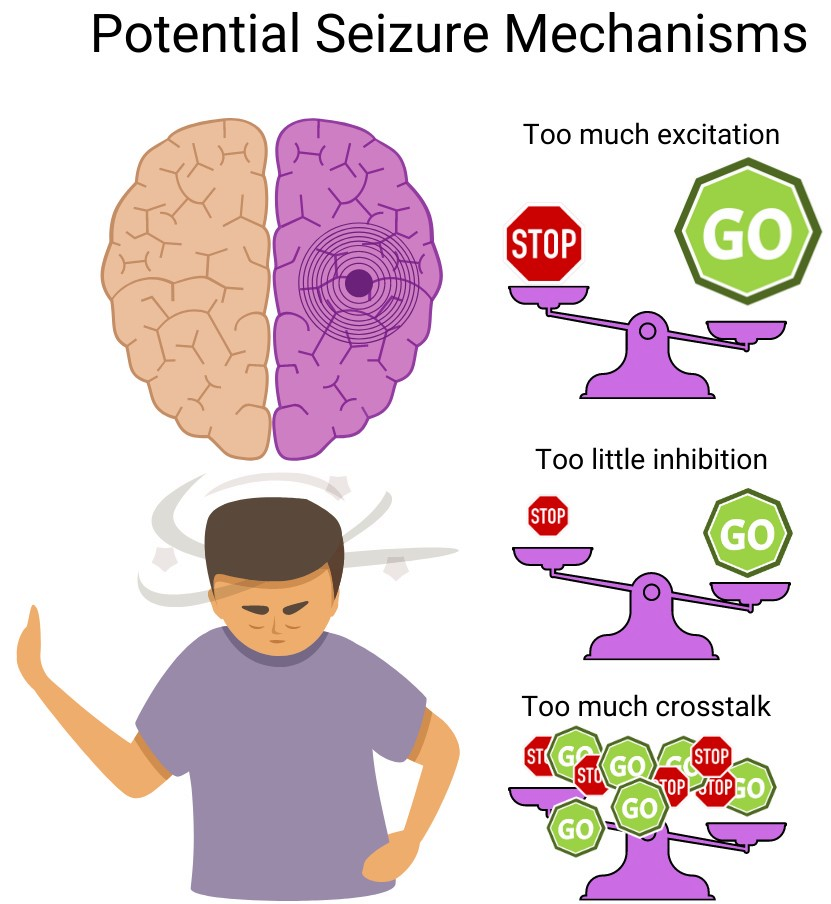
Your brain is a well-regulated lightning storm; at any given moment electrical signals are flowing through billions of neurons that help you see, feel, move, talk, and even breathe. Much like the electrical wiring to your house, you can harness that electricity effectively and “do it all” because it’s routed through the right cords to the right appliances.
You can imagine a number of ways this situation could go wrong:
When a change in the brain’s electrical state causes a change in behavior, we call that event a seizure. Anyone can experience a seizure, but under normal circumstances the brain’s safety mechanisms prevent them. People who are disposed to experiencing repeating, stereotyped seizures are considered to have an epileptic disorder.
Identifying epilepsy
Because epilepsy is defined by seizures that can be subtle, short-lived, variable in appearance, and stressful for everyone involved, it can be difficult to diagnose.
To envision this more intuitively, imagine your brain as a pond. The pond is constantly experiencing ripples in response to animals and wind and dropping objects; those ripples will bump into one another and interact as part of a larger pattern. A seizure is like a crashing wave that overtakes all of those smaller ripples.
If this big wave happened once, it might be hard to figure out why it happened. But if the big waves keep disrupting the quiet peace of the pond in the same way, we might look for patterns and causes: Maybe somebody practices their cannon-balls in the pond or skips rocks, or maybe there’s something underneath the water. Epilepsy is an umbrella phrase for things in the pond that might cause disruptive waves.
This is further complicated by the fact that definitions of epilepsy and seizures have shifted over time as our understanding of the brain advances. A good place to start is with how the seizures impact the patient
Seizure types
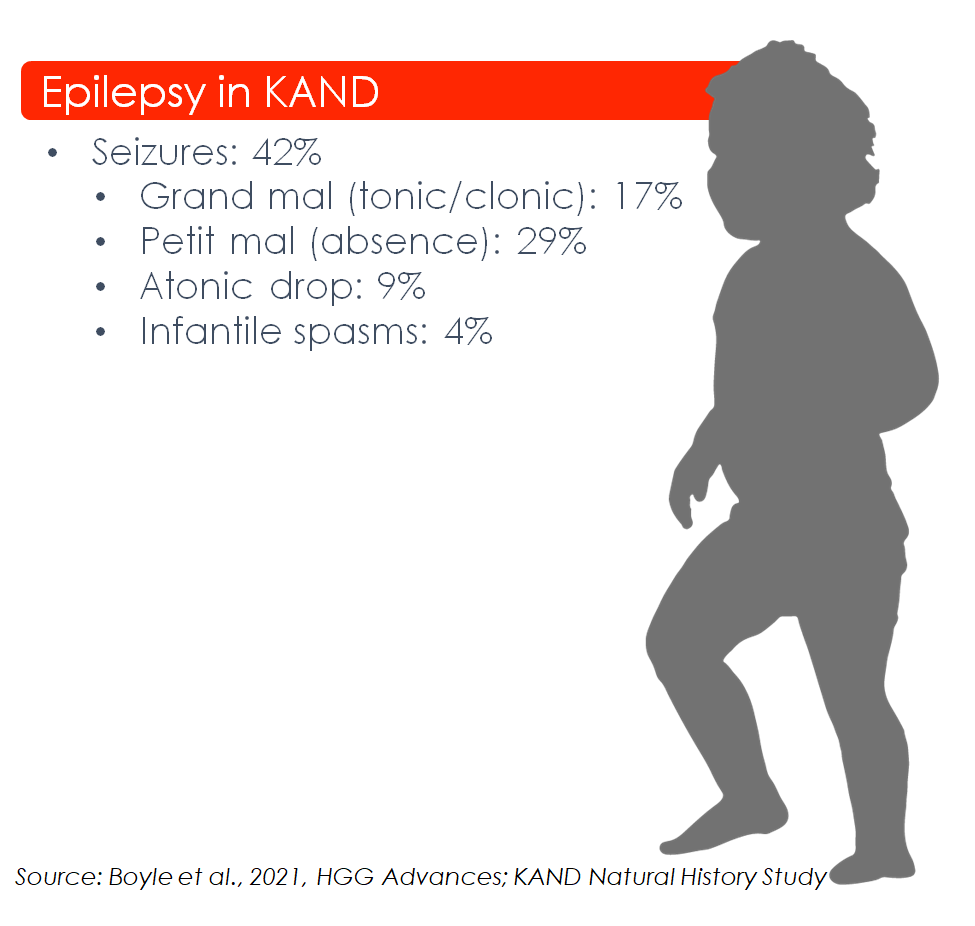
These are the endpoint “effects” or “symptoms” of the seizures, and the first sign that is likely to alert families about potential epilepsy. Different patients have different seizure types, and one patient may experience multiple types; here is a list of seizure manifestations seen in KAND:
Patients without epilepsy may experience similar-looking symptoms; working with a clinical specialist is crucial for distinguishing epilepsy from other neurological disorders.
Visiting your Epileptologist
Epileptologists are clinicians who specialize in interpreting the brain’s electrical activity during the diagnosis and treatment of epilepsies. We’ve consulted with Dr. Tristan Sands, co-lead of the KAND EEG study, to create a one-page resource on epilepsy in KAND to guide your initial conversations:
What information should I provide about KAND?
Overnight/24hr EEG: Dr Tristan Sands from Columbia University Medical Center co-leads the KAND Epilepsy and EEG study. Because KAND can cause abnormal electrical activity during sleep, he and other KAND specialists highly recommended an EEG with recorded sleep, or ideally an overnight/24hr EEG. These longer recordings are more likely to detect abnormal activity, including epileptic spikes and seizures at night.
There are two primary factors that contribute to epilepsy diagnosis
1. Observations of patients during seizures
What should I bring to my appointment?
Video recordings of suspected seizures are one of the best tools families can provide their epileptologist; seizures are stressful events and self-report/interviews may miss crucial details. Seeing which aspects of a patient’s behavior change can inform clinicians about what might be happening in the brain.
2. Measurements of the brain’s electrical activity with an electroencephalogram (EEG)
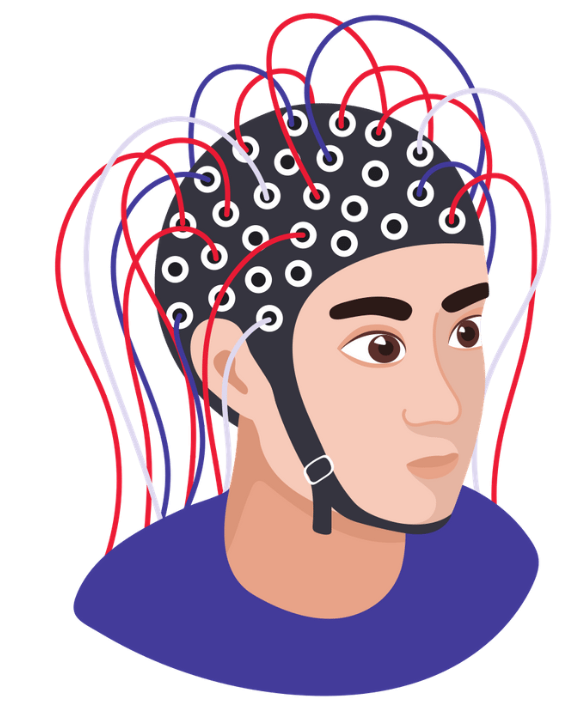
An electroencephalogram (EEG) uses electrodes placed on the scalp to record the brain’s electrical activity.
EEG
There are many types of seizure, even when we know the primary cause is genetic in KAND. Seeing the “source” of the seizure with EEG is crucial for understanding the type of seizure and impacts the management and treatment. For example, EEG can determine where in the brain the seizures originate:
This information is crucial because the area in which seizures originate can be related to the types of seizure symptoms the patient experiences.
EEG also lets epileptologists look for nuances that can help distinguish seizure types, or even identify abnormal electrical activity that happens between seizures; these all play a crucial role in diagnosing and treating epilepsies.
After your visit
Request Raw files for KAND EEG study: Once your EEG is complete, you can request that your physician provide a raw EEG data file afterward. Our clinical researchers need these data files for the first-ever KAND-specific EEG study to find patterns within our community.
Considerations for medications
For a disease community as heterogeneous as KAND, it’s important to consider how different symptoms can be researched and therapeutically approached. There are many advantages to investigating epilepsy in KAND:
Discussion with Dr. Tristan Sands, co-lead of the KAND EEG study
https://youtube.com/watch?v=FhbgXd_0ZmU%3Ffeature%3Doembed
Kang Daniel in July 2022
BornDecember 10, 1996Busan, South Korea
EducationKyung Hee Cyber University
Formerly ofWanna One
Website강다니엘 (Kang Daniel)Kang Daniel Japan
Alongside his music career, Kang appeared as the host of Mnet’s Street Woman Fighter (2021), the spin-off show Street Dance Girls Fighter (2021–2022), the one-episode television special titled Be the SMF (2022) in addition to Street Man Fighter (2022) as well as Street Woman Fighter 2 (2023). He also made his acting debut through the first-ever Korean Disney+ Star original series, Rookie Cops (2022). His other ventures include establishing an independent entertainment company named Konnect Entertainment to manage his own career that has since expanded to manage other artists in addition to himself.
Life and career
Kang Daniel at One: The World in Seoul on June 1, 2018
Solo debut with Color on Me
Kang Daniel at SBS Power FM for "2U" promotions on April 7, 2020
Acting debut, The Story, and concert tour
Gyeongbokgung Palace at night
Kang Daniel at Think Nature fan meet on January 6, 2018
Fashion and modelling
10/8/2023 -11:00 AM
Host: Oglebay Resort Location: Wheeling, WV
PAC 8 XC Championship
10/12/2023 – 3:20 PM
Host: Wheeling Park HS
Region I-AAA Championship
10/19/2023 – 10:00 AM
10/21/2023 – 9:30 AM
Host: Mountain East Conf.
Crazy Run – Fredrick, MD
Host: Crazy Running
Let’s Get Physical 5K
11/11/2023 – 8:00 AM
Host: Wheeling DPT Club Location: Wheeling, WV
Results brought to you by our Leader sponsor:
Providing meet management solutions for all ages
K&J Timing offers a mix of services to support your meet management needs. With a combination of 100-years of track, cross country, and meet management experience, let our team help you host your next event.
Want to know more about our services or have a question? Let our friendly team assist you by filling out the form below. Be as detailed as possible so we can assist you quickly!